The 47:1 Problem
Why India's higher education system is at a breaking point—and how AI can provide the personalized support students deserve
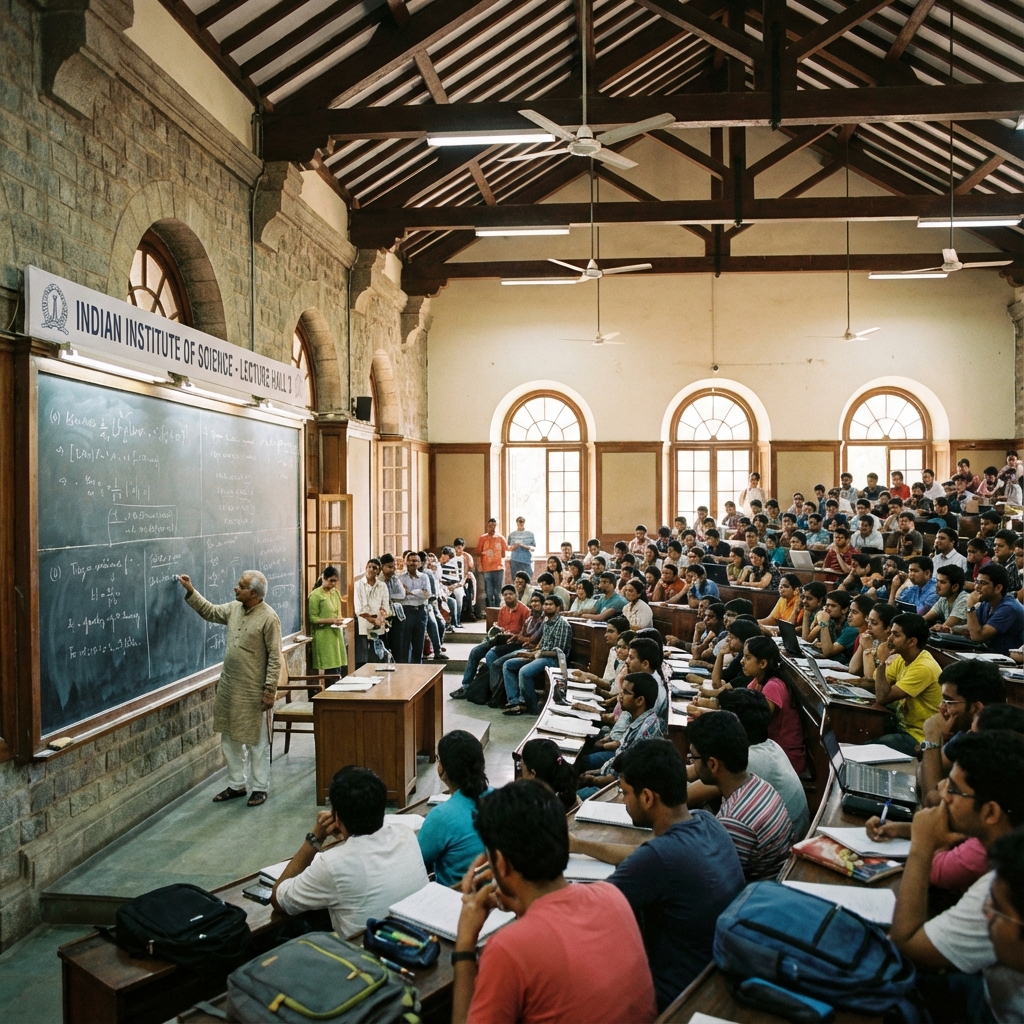
India's demographic dividend is often discussed in terms of opportunity. But in the world of higher education, it's often discussed in terms of a ratio: 47 to 1.
According to the Ministry of Education's All India Survey on Higher Education (AISHE), the student-teacher ratio in many Indian universities has reached a critical bottleneck. While the ideal ratio is closer to 15:1 or 20:1, the reality on the ground is classrooms packed with 50, 80, or even 100 students for every single faculty member.
The "47:1 Problem" isn't just a number. It's an educational crisis that prevents personalization, stifles curiosity, and leaves millions of students without the mentorship they need to succeed.
The Human Limit of Teaching
A teacher with 47 students cannot provide personalized feedback. They cannot answer 47 different questions about a complex engineering principle during a one-hour lecture. They cannot grade 47 essays with the depth and nuance required for high-level learning. The human limits of time and attention mean that most students in a 47:1 environment are receiving a broadcast education, not a participatory one.
As a result, students increasingly turn to "coaching centers" and private tutors to fill the gap. This creates a two-tiered system where only those who can afford extra help receive the personalized instruction and mentorship required for career success. For the rest, higher education becomes a race to memorize and repeat, rather than to understand and apply.
Scaling the Unscalable
The traditional solution to this problem is to hire more teachers. While India is making efforts to do so, the sheer scale of the population means we cannot hire our way out of this crisis fast enough. We need a way to provide personalized support that doesn't scale linearly with human headcounts.
This is where AI-powered pedagogical support comes in. Not as a replacement for the professor, but as a way to provide every student with a "Personal Teaching Assistant" that is available 24/7.
- Instant Query Resolution. In a 47:1 classroom, a student who gets stuck on a concept in minute 10 of a lecture is lost for the remaining 50 minutes. AI assistants grounded in the actual course curriculum can answer those clarifying questions in real-time, keeping the student engaged and on track.
- Scalable Personalized Feedback. AI can provide immediate, detailed feedback on assignments and practice exercises. It can point out specific logical errors in a coding project or provide suggestions for improving the structure of a thesis—tasks that a overwhelmed professor might not get to for weeks.
- Knowledge Accessibility. AI can translate complex academic jargon into simpler, more relatable terms. It can provide diverse examples of a single principle to help students with different learning styles grasp the core concept.
The Accuracy Challenge in Education
In education, accuracy is everything. An AI that provides incorrect mathematical formulas or misinterprets historical facts isn't just unhelpful; it's detrimental to the student's future. Generic AI models are too prone to hallucination to be trusted as primary educational resources.
This is why Episteca's "Bounded Knowledge" approach is so vital for the academic sector. By grounding the AI teaching assistant *only* in the university's approved textbooks, lecture notes, and research papers, we ensure that every student is receiving information that is academically rigorous and aligned with their specific curriculum.
We're not just giving students an AI; we're giving them a gateway to their specific field of study, curated and verified by their own university.
The Future of India's Dynamic Classroom
Solving the "47:1 Problem" is the key to unlocking the potential of India's youth. By using AI to handle the heavy lifting of information retrieval and basic query resolution, we can free up our professors to do what humans do best: mentorship, high-level critical thinking, and inspiring the next generation.
The classroom of the future won't be empty. It will still have 47 students. But each of those 47 students will have a personalized learning path, an instant support system, and a way to prove their knowledge. We are moving from a broadcast era of education to an era of individualized excellence at national scale.
Transform Your University
Learn how Episteca is using AI to bridge the ratio gap in higher education.
Book a Demo